





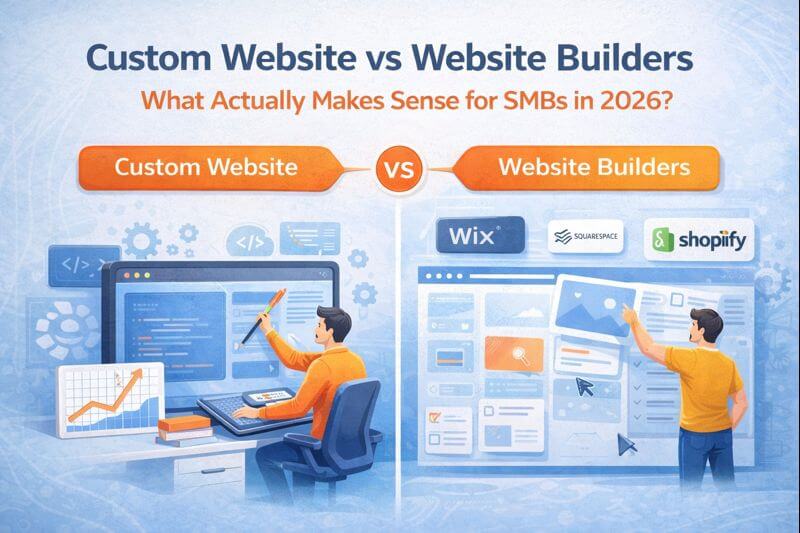
If you’re a small or medium-sized business owner planning a website in 2026, chances are you’re stuck with one big question:
Should we use a website builder like Wix or Squarespace, go with WordPress, or invest in a fully custom website?
Each option promises speed, affordability, and results. Each comes with trade-offs that are often not clear upfront.
The wrong decision can cost you lost leads, poor scalability, and rebuilding the site again in 1 to 2 years.
This article breaks down the real differences, without hype or bias, so you can make the right decision for your business, not just for today, but for where you’re going.
Why SMBs Are Confused (And It’s Not Their Fault)
The market is crowded with opinions. Builders promise “launch in a day.” Agencies push “custom is best.” Freelancers recommend WordPress for everything.
What’s missing is context.
There is no one-size-fits-all solution. The right choice depends on your business stage, goals, and growth plans.
Let’s look at each option honestly.
Option 1: Website Builders (Wix, Squarespace, Shopify)
What They Are
All-in-one platforms that let you build and publish a website quickly using templates and drag-and-drop tools.
When They Make Sense
You’re just starting out. You need a simple brochure site. Your budget is limited. You don’t need advanced functionality. Speed matters more than customization.
Pros
Fast to launch. Low upfront cost. Hosting, security, and updates included. Minimal technical knowledge required.
Cons
Limited customization. Performance and SEO constraints. Hard to scale beyond basic needs. Vendor lock-in (moving away later is painful). Generic design (many sites look the same).
Reality Check
Website builders are great for early-stage SMBs, but often become restrictive as the business grows.
Option 2: WordPress (Themes + Plugins)
What It Is
A flexible content management system used by over 40% of the web, typically customized with themes and plugins.
When It Makes Sense
You want flexibility without full custom cost. Content marketing and SEO matter. You expect moderate growth. You want control over hosting and data.
Pros
Highly flexible. Strong SEO capabilities. Large ecosystem of plugins. Easier to scale than builders. Ownership of your website.
Cons
Requires ongoing maintenance. Plugin conflicts can cause issues. Security depends on setup. Performance varies based on implementation. Quality depends heavily on who builds it.
Reality Check
WordPress is a strong middle ground, but only when built properly. Poorly built WordPress sites can be slow, insecure, and hard to manage.
Option 3: Custom Website Development
What It Is
A website designed and developed specifically for your business, goals, and users, without template limitations.
When It Makes Sense
Your website is a lead generation engine. You need custom workflows or integrations. Performance and scalability matter. You operate in a competitive or regulated market. You plan to grow significantly.
Pros
Fully tailored to your business. Better performance and UX. Scalable architecture. Easier integration with tools and systems. Strong foundation for long-term growth.
Cons
Higher upfront investment. Longer development timeline. Requires a reliable development partner.
Reality Check
Custom websites are not “better by default.” They are better when the business needs them.
Quick Comparison (At a Glance)
Cost Website Builders: Low WordPress: Medium Custom Website: High
Speed to Launch Website Builders: Very Fast WordPress: Fast Custom Website: Moderate
Customization Website Builders: Limited WordPress: High Custom Website: Unlimited
Scalability Website Builders: Low WordPress: Medium Custom Website: High
SEO Potential Website Builders: Limited WordPress: Strong Custom Website: Excellent
Long-Term ROI Website Builders: Low to Medium WordPress: Medium to High Custom Website: High
The Question You Should Actually Ask
Instead of asking “Which platform is best?” ask “What does my business need from a website in the next 2 to 3 years?”
If your website is just an online presence, a builder may be enough. If it supports marketing and growth, WordPress or custom may be better. If it drives revenue, custom often pays for itself.
Common Mistake SMBs Make
Many SMBs choose the cheapest or fastest option, then rebuild their website within 12 to 24 months because it doesn’t convert, it doesn’t scale, or it doesn’t integrate with their systems.
That second build usually costs more than doing it right the first time.
Talk to an Expert Before You Decide
Choosing the right website approach is a business decision, not a technical one.
A short conversation with an experienced team can help you avoid unnecessary costs, choose the right platform for your goals, and plan a website that grows with your business.
If you’re unsure which option makes sense for your SMB in 2026, talk to an expert before you decide.
We offer honest, no-pressure guidance to help you choose the solution that fits your business, not our sales pitch.
Get a free consultation and make the right choice for your business.