





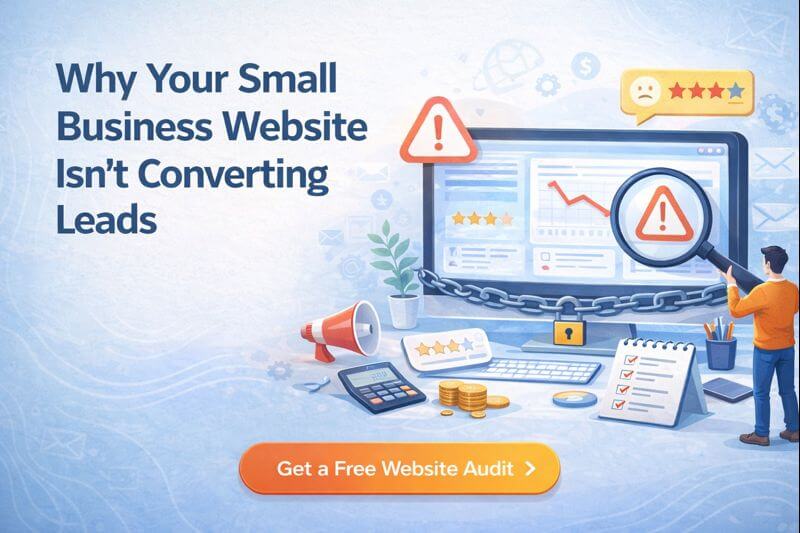
You invested time and money into your website. It looks decent. It’s live. But the phone doesn’t ring. Emails don’t come in. Leads are inconsistent or nonexistent.
If this sounds familiar, you are not alone.
One of the most common frustrations we hear from small and medium-sized businesses is: “We have a website, but it doesn’t bring us any business.”
The problem is rarely having a website. The real issue is that most small business websites are not built to convert visitors into leads.
Let’s break down why this happens and, more importantly, how you can fix it within 30 days.
The Real Reason Most Small Business Websites Fail
A website is not a digital brochure. It is a sales and lead generation tool.
Unfortunately, many SMB websites are built with the wrong priorities: design over strategy, information over persuasion, and traffic over conversion.
Here are the most common reasons they fail.
1. No Clear Value Proposition (Visitors Don’t “Get It”)
When someone lands on your website, you have 5 to 7 seconds to answer three questions:
- What do you do?
- Who is it for?
- Why should I choose you?
Most small business websites fail this test.
Generic headlines like “We Provide Quality Services” or “Your Trusted Business Partner” mean nothing to a visitor. They’re too vague to make an impact.
How to Fix This (Week 1)
Rewrite your homepage headline to clearly state what problem you solve, for whom, and what makes you different. Place this message above the fold where visitors see it immediately.
If visitors are confused, they will leave, no matter how good your services are.
2. Poor Calls to Action (Or Too Many of Them)
Many SMB websites either have no clear CTA, or they have too many competing CTAs fighting for attention.
“Contact Us,” “Learn More,” “View Services,” “Read Blog.” When visitors see all of these at once, they don’t know what to do next. So they do nothing.
How to Fix This (Week 1 to 2)
Choose one primary CTA per page, like “Get a Free Consultation.” Make it visually prominent. Use action-oriented language. Place it multiple times strategically at the top, middle, and bottom of your page.
Your website should guide visitors, not overwhelm them.
3. The Website Is Built for the Business, Not the User
Many websites focus heavily on company history, internal processes, and long paragraphs about “who we are.”
Here’s the truth: visitors don’t care about you yet. They care about their problem.
How to Fix This (Week 2)
Rewrite key pages from a customer-first perspective. Focus on pain points, outcomes, and benefits (not features). Use simple language, short sections, and scannable layouts.
This is where UI/UX and conversion rate optimization play a critical role.
4. No Trust Signals (Visitors Don’t Feel Safe Reaching Out)
Trust is everything for SMB buyers.
Common trust killers include no testimonials or reviews, no real client names or results, no physical address or company details, and stock images instead of real visuals.
Even interested visitors hesitate if they don’t feel confident in your business.
How to Fix This (Week 2 to 3)
Add visible trust elements such as client testimonials with names and roles, case studies or short success stories, certifications or review platform badges, and clear contact details and business information.
Trust reduces friction. Reduced friction increases leads.
5. Slow Speed and Poor Mobile Experience
More than half of SMB website traffic comes from mobile devices.
If your site loads slowly, is hard to navigate on mobile, or has unreadable text or broken layouts, visitors will leave before engaging.
How to Fix This (Week 3)
Optimize page speed. Improve mobile responsiveness. Simplify navigation. Reduce unnecessary animations or heavy assets.
Performance is not a “technical detail.” It directly impacts revenue.
6. No Lead Capture Strategy
Many SMB websites rely only on a single “Contact Us” page with a long, intimidating form. This misses a huge opportunity.
How to Fix This (Week 3 to 4)
Introduce low-friction lead capture options like a free website audit, free consultation call, or simple inquiry forms that only ask for name and email at first. Make the next steps clear after submission.
Give visitors a reason to contact you.
What You Can Realistically Fix in 30 Days
Here is a practical 30-day roadmap:
Week 1: Clarify value proposition. Fix headlines and messaging. Define primary CTA.
Week 2: Improve UI/UX and page structure. Rewrite content for user intent. Reduce clutter.
Week 3: Add trust signals. Optimize performance and mobile UX.
Week 4: Improve lead capture. Test CTAs and forms. Track conversions.
These changes do not require rebuilding everything, but they require expertise and an objective audit.
The Fastest Way to Know What’s Broken: A Website Audit
If your website is not generating leads, guessing is expensive.
A professional website and conversion audit identifies why visitors are leaving, what’s blocking conversions, and what to fix first for maximum impact.
Get a Free Website Audit
We offer a no-obligation website audit for small and medium-sized businesses.
You’ll receive clear, actionable insights, UX and conversion recommendations, performance feedback, and honest guidance with no pressure.
If your website should be bringing you business but isn’t, let’s fix that.
Request your free website audit today and start turning visitors into leads.